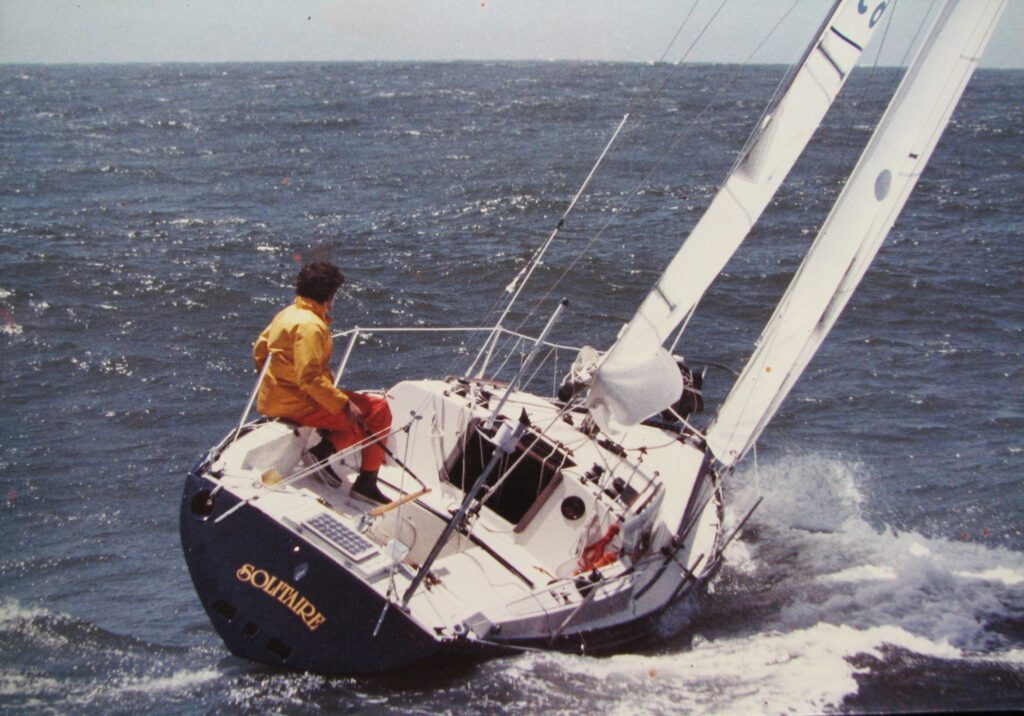
The first ocean waves leaving San Francisco in the single handed race to Hawaii*
We have been caught in a trap of valuing progress as a panacea for every problem and unfulfilled wish. Blinded by the rapid expansion of wealth and comfort, we could not see the damage it was causing personally and to the earth. As we face the consequences of our collective myopia, drastic changes will be required to live on this planet. To adapt will require courage, resilience and cooperation. Resilience is a word that is used a lot by people writing about the polycrisis, but often they are speaking of creating physical or social infrastructure to help a community survive, or just simple preparedness measures like having extra batteries for your flashlight. I am interested in exploring the psychological and spiritual qualities that allow an individual or group to survive and sometime even thrive in adverse conditions. Webster defines resilience as: 1) the capability of a strained body to recover its size and shape after deformation caused especially by compressive stress. 2) an ability to recover from or adjust easily to misfortune or change.
We have become accustomed to a stable platform on which we pursue our daily life. We regulate the temperature of our environment with the touch of a thermostat. Our food supply is grown, inspected for quality and brought reliably to a store near us without any effort on our part. This is a very recent accomplishment in our history. I see these “conveniences” lowering
our capacity to recover from stress, and adjust easily to misfortune or change. In more primitive cultures the natural world ruled life. Changes in weather required adaptation with minimal ability to mitigate cold, heat or storms. Food supply was never dependable making long migrations necessary and sometimes starvation prevailed, decimating the population. We not only survived, but became the dominant species on the planet by being adaptable, and learning to work together as a community, sharing resources, food and labor to support the entire community, not just the individual.
I see the need for resilience on multiple levels: individual, community and in connection with the whole. On an individual level it is primarily a state of mind, and a quality of awareness, both of which have significantly atrophied due to our lifestyle. These qualities were essential for survival and were highly developed in indigenous cultures. They arise and are honed by living embedded in nature, dependent on her, and for the most part unable to isolate themselves from her fluctuations. A key attitude in this process is taking full responsibility for ones life and well being within the framework of the primary goal of supporting the long term survival of the band or tribe. It is rare that we have that opportunity in this culture because our safety and well being are outsourced to government, contractors, farmers, grocers and mechanics.
Individual Resilience – full responsibility
I first experienced the pleasure and awe of that level of responsibility when I competed in a single handed sailboat race from San Francisco to Hawaii. It was in the days before GPS and satellite phones, so once I was out of range of my VHF radio (about 10 miles) I was on my own. The exhilaration of being free from the constraints of civilization was huge, and it came with a healthy dose of fear. Without going into detail, there was a series of equipment failures, a leak that saturated my bunk and sleeping bag, unexpected weather issues, fatigue, and cold, all in the first 3 days. When my autopilot broke I thought I would have to turn around and limp back to the coast, but with each problem that came up I was able to find some solution and keep going. It was not a clear path, but a roller coaster ride between curling up exhausted on the cabin floor with no idea of how to proceed, then, after a couple of hours of sleep, solving some aspect of the problem, and feeling the satisfaction of getting the boat moving again. Repairs were made without spare parts and with limited tools. Each step was a creative process that came out of a clear seeing of the forces involved and the materials at hand that could be used in unconventional ways. I had completely abandoned the idea of being competitive in the race because of all the problems that slowed me down, so I was very surprised to find that I was the first boat to arrive at the finish line. In my focus on my own problems, I failed to consider that other competitors would face their own difficulties. There is a saying about sailboat racing that the winner is not the one who makes the fewest mistakes, but the one who can recover most rapidly from his mistakes.
Awareness
Awareness of ones surroundings, is critical. It is a quality of relaxed vigilance that includes all the senses and all directions. We are accustomed to focusing our eyes straight ahead either on the highway or on the computer screen. If we are aware of sounds or smells while we are driving it is usually just to roll up the window if we pass a truck spewing diesel exhaust, or to change the station on the radio. A hunter must use all his senses and be equally aware of sounds and smells behind him as well as in front or he will miss his dinner or perhaps be dinner for some other creature because he did not hear the snap of a twig behind him. Sailing also requires a global awareness, especially steering a boat on a night with no stars visible, depending on the sensation of the waves moving under the boat and the wind on the skin of ones face to keep it on course. Another example came one dark night while sailing from Newfoundland to Greenland. The woman on watch called to wake me with some urgency. I came on deck-quickly, but saw nothing out of order. She said the wave pattern had changed and she suspected there was ice close by ahead. Sure enough within 5 minutes we were in the midst of huge icebergs and their more dangerous offspring called bergy bits.
Humility
A third aspect arises from a deeper understanding of our place in the world as just one of millions of life forms at the mercy of forces far greater than us. We have developed an extraordinary level of arrogance, believing that we can and in fact have a right to control natural forces. This leads to a “man against nature mentality”, which is unsustainable. When we enter into a changing world with this adversarial attitude, we try ever harder to maintain that control, using ever greater resources and technology to do it. To truly be resilient requires the willingness to surrender, to give up our argument with God, and to accept things as they are without feeling defeated or descending into despair. From there, new possibilities emerge to live cooperatively with the evolving new normal.
When we live embedded in nature, we develop an innate trust in her and in our capacity to survive. In the example of the race to Hawaii, giving up on the idea of being competitive gave me the time and freedom to think of solutions that I would not have considered if speed was my primary focus, but which were in fact quite efficient. The first nations elder, Ilarion Merculieff frequently mentioned that his people, despite living in the harsh environment of the Pribilof Islands in the Bering Sea, never stored food, but always trusted that they would find what they needed. It is an attitude shared by many indigenous people and is especially noteworthy among those peoples of the far north. That level of trust only comes when a person no longer feels separate from his surroundings, but knows that he is embedded in and held by the spiritual force of the natural world.
Collective resilience
Aboriginal societies throughout the world speak of the importance of the community bond that is carefully nourished in those societies. For them, the community included all the creatures and the land itself. The earth was alive, the rocks had a voice that needed to be heard. However, the bond with human inhabitants in a community provides great strength and peace of mind. It is empowering to know that everyone in the band has your back, that if there is hardship, you do not have to struggle alone, not only because several people working together are stronger and more resilient that a single person, but also because it gives purpose to each person’s life. There is a sense of obligation to care for the rest of the tribe, so one member cannot give up or leave without facing the guilt and shame of letting down the rest of the tribe. This is a natural development on a sailing boat at sea. It comes not because a leader is advocating for it, but because it is obvious to all that the safety of the boat and crew depends on everyone doing their part and supporting each other. If one crew member is exhausted or for some reason cannot perform a task as well as another crew member, another person will fill in. There is no issue of bruised egos as long as the common goal of finishing the race is uppe most. I think of it as a natural state of humility, and from that perspective, it becomes natural to treat the whole environment with the same respect. I remember one passage where the navigator came on deck each evening with her sextant and greeted each star by name before taking a sight. The stars were in fact all friends and we depended on them to find the island we were bound for.
We spend most of our lives working to insure that we or our immediate family are taken care of. We no longer have the structures in our society that encourage or support community well being. Most of us live in towns or cities that are too large to get to know and trust each individual. The resilience of a community is directly related to the trust each member has in every other member and in the leadership of the community. To develop resilient communities on this level requires the redesign of urban living to create pods that are small enough to allow for the development of trust so each member feels safe in the group. It is a tall order, given the hundreds of years we have been enculturated with the values of individualism. Hopefully we all have close friends with whom we share that level of trust, but they may not be nearby in a time of need. People have tried many different options to deal with this structural problem such as co-housing and intentional communities, but the majority of us still live in individual residences and seem to prefer that. Like many of the changes in lifestyle that will become essential as the great unraveling continues, housing patterns will change, and we will have to develop new solutions.
How do we live now?
The importance of reconnecting with the natural world is echoed by many writers both western and indigenous. The first reaction may be that it is not possible for those of us living in a city, but at one time we were all indigenous to a particular place. We have that experience in our genetic memory and may feel the longing for place, but do not recognize it, do not associate it with our restlessness or subtle discontent. If we direct that longing to opening our senses to our immediate environment, without judgment, even if it is mostly concrete and steel, it can become a practice of resilience. To see the world around us without pushing it away or grasping on to it is a key component in developing the ability to adapt to a changing environment and the resulting stress of not being able to predict the future.
Photo by Jan Pehrson