The official position of every government is that we can muddle through this crisis and keep the economy growing albeit at a slower pace. Ask a scientist about climate change and they will say that we need to make a radical reduction in carbon emissions or suffer serious consequences. Ask a fisheries biologist and hear that the ocean fish populations are in grave danger if we do not change. Ask an energy resource expert and they will tell you that it is highly unlikely that we can power our present lifestyle solely on renewables. Ask most economists and they will tell you that the debt, both national and private, are reaching unsustainable levels and will eventually reset with a massive string of defaults and political disruption. Yet few put it all together. Few see that the failure of each system feeds into the failure of the other.
One: Endless growth. We’ve created a system of economics based on valuing money and charging interest for its use. Every time that the bank loans money, it is creating more money and for the use of that money we pay interest. The only way to repay that interest is to keep the economy and private businesses growing, funneling the profits to the banks, investors and taxes to support federal spending. Unfortunately, representatives in a democratic government are reelected only if they can give their constituents consistent bonuses. We want all the things we think will make our life better and our representatives in Congress want to give us those things so the government is continuously going further into debt. On the private side corporations have to keep selling us more things in order to survive. They too have to pay interest and reward stockholders with growth or dividends. They are trapped into having to make more appealing products so they can sell them to people who don’t even need them. All of this consumes and ever increasing amount of resources. The Earth, however, is finite. It can only give so much before the ecosystem collapses and the mines play out.
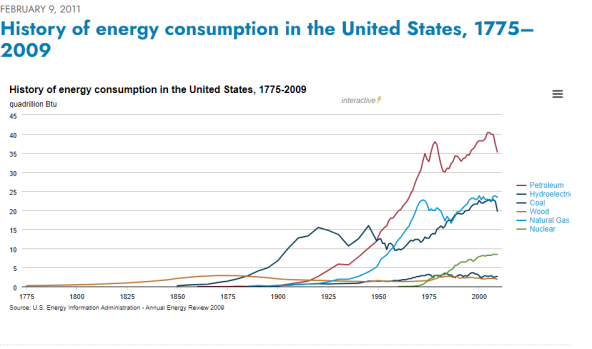
Number Two Environmentalists hold on to the belief that if only we can produce enough solar panels, we can transition from fossil fuels to renewables without giving up our lifestyle of high energy consumption. There is no evidence that this is ever happened. Instead, each new energy source merely adds to the original source. When coal replaced wood, the consumption of wood actually increased in England because there is more need for wood to shore up the mines and for railroad ties and other construction. When oil replaced coal, coal consumption kept increasing because it was needed to produce steel for the industrial revolution. Looking at the current situation, wind and solar are increasing rapidly, but other sources are not decreasing. The total energy consumption keeps increasing as we grow more hungry for stuff and grow more people to use it. Each time a new energy source comes online, there is a tremendous need for new infrastructure to support it and that requires energy from the old modes of energy production. The problem is that it takes more energy to extract energy from the newer sources then from the originals. For instance, early oil wells produced 100 barrels of oil for every barrel expended in drilling, now that ratio is down to 16:1 or less. The cost of converting to wind and solar would consume vast amounts of resources. We can migrate away from fossil fuels for energy, but we will have to reduce our energy consumption by 50% to 70%.
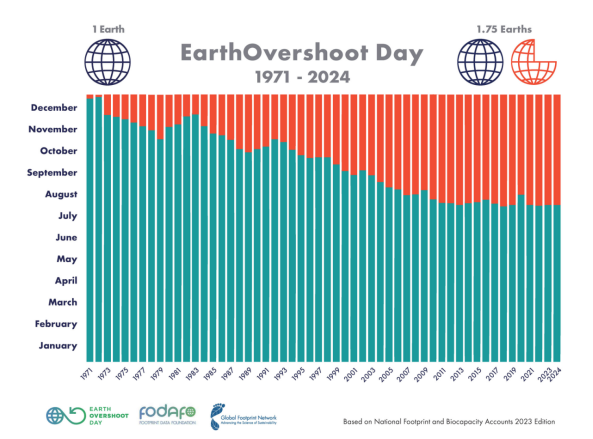
Number Three The Earth can support 10 billion people. According to the global footprint network, we are currently using 1.7 earths. If we want to bring all people on the planet up to some decent standard of living that number would radically increase. Yes we could probably support 10 billion people if we all lived in extreme poverty, but not too many of us are willing to go back to living in thatched huts, traveling by bicycle and working long hours to grow enough food in our minimal plot of land to survive. Various experts have estimated that the carrying capacity of the earth is between one and 3 billion people. How do we get there? If we keep going with business as usual, the Earth will show us how. It will not be pleasant. We are already getting a taste when we look around the world and look at the floods, the fires, the wars, the famine. Perhaps of even greater concern is the loss of other species. The Earth is an unimaginably complex web of species some of which we don’t even know yet, and they are all important. The danger extreme danger in the present is that we humans will try to maintain our lives at the expense of the natural world and we will destroy the fundamental building blocks of life on this planet through environmental degradation, chemical pollution, and radical climate change.
Number Four We cling to the illusion that through our technology and our “superior“ intelligence, we can maintain a stable and comfortable life now and in the future. We believe that through geoengineering such as carbon capture we can mitigate the damage we have already done and continue on with business as usual. All solutions cost more energy, and it is precisely the continual increase in our extraction of energy that is the problem. The solution is to reduce our energy consumption rather than create new technologies that increase consumption, even if they give us a momentary pause in climate disruption.
Here in the United States we have been isolated from the long term history of Europe and Asia with the rise and fall of multiple empires, and as a result we forget or ignore that every empire in history has risen to prominence and then collapsed when its geography or population exceeded the capacity of the land or government to govern or feed their people.
We can look at this as a failure of the human being, an inevitable outcome of his hubris, but it is a more mechanical process than that. Biologist are familiar with the pattern among animals of overshoot and collapse as the population grows past the point that their land base can sustain the herd. The population then collapses to a point well below the initial population because the terrain has been stripped of everything edible and takes years or decades to return to its productive level. Looking at it from a systems view, it is a matter of the feedback mechanism that tells the humans or the animals to stop producing young is delayed past the point where a stable population can be maintained. Humans have better better access to data. But we are very bad at making use of that information and turn a blind eye on the fact that we don’t want to see. For 25 years it’s been clear that climate change is the greatest threat to humans and animals that that we have faced since the evolution of Homo Sapiens, but we made only superficial steps to solve the problem, and half the population of our country still denies climate change is real, even as they get flooded out of their home.
Number Four We cling to the illusion that through our technology and our “superior“ intelligence, we can maintain a stable and comfortable life now and in the future. We believe that through geoengineering such as carbon capture we can mitigate the damage we have already done and continue on with business as usual. All solutions cost more energy, and it is precisely the continual increase in our extraction of energy that is the problem. The solution is to reduce our energy consumption rather than create new technologies that increase consumption, even if they give us a momentary pause in climate disruption.
Here in the United States we have been isolated from the long term history of Europe and Asia with the rise and fall of multiple empires, and as a result we forget or ignore that every empire in history has risen to prominence and then collapsed when its geography or population exceeded the capacity of the land or government to govern or feed their people.
We can look at this as a failure of the human being, an inevitable outcome of his hubris, but it is a more mechanical process than that. Biologist are familiar with the pattern among animals of overshoot and collapse as the population grows past the point that their land base can sustain the herd. The population then collapses to a point well below the initial population because the terrain has been stripped of everything edible and takes years or decades to return to its productive level. Looking at it from a systems view, it is a matter of the feedback mechanism that tells the humans or the animals to stop producing young is delayed past the point where a stable population can be maintained. Humans have better better access to data. But we are very bad at making use of that information and turn a blind eye on the fact that we don’t want to see. For 25 years it’s been clear that climate change is the greatest threat to humans and animals that that we have faced since the evolution of Homo Sapiens, but we made only superficial steps to solve the problem, and half the population of our country still denies climate change is real, even as they get flooded out of their home.
Posted inUncategorized|Comments Off on Myths We Live By That Can Kill Us
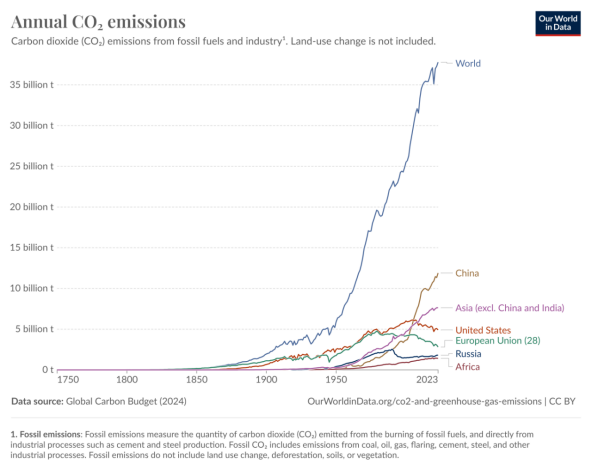
For some, the election of President Trump to a second term is a disaster, but let’s step back and take a longer view. It is true that Kamala Harris stood for many values that appealed to the “liberal” community, but there was nothing new. Her platform promised tweaks around the edges to hold the ecosystem, and the economy together a little longer, but did not address the fundamental problem that this economic, and political system is unsustainable in the long run. Over the past 50 years it has become clear that the democratic system, which is by nature fixated on 4 year time segments, cannot address the overriding issues of our time such as climate change, resource depletion and other elements of the polycrisis. On the financial side, the capitalist economy is designed around the untenable concept of unlimited growth on a finite planet, with the net result that the global footprint of humanity in 2024 is 1.73 earths. For years the environmental community has been saying that we must reduce our carbon emissions, but every year, with the exception of the pandemic in 2020, emissions keep rising. Trump followers voted against the status quo. Many of them apparently did not realize what the consequence of their vote would be due to the spread of disinformation, but they were correct in their sensing that something is wrong with the system, but neither they nor Trump have a clue what it is or how to fix it.
Eventually some degree of chaos will result. In that period there may be an opportunity to create new models that will acknowledge the earth and the biosphere as a fundamental part of us, and not as something to be exploited. If there are no new models ready to fill the gap, the usual outcome is something worse, governments that turn to totalitarian rule, economic systems that exacerbate the transfer of wealth to the rich. Our task is to create alternatives on a local scale and to build trust within the community in new ways, and then link up communities that are exploring alternative models to form a coherent network. There are a lot of options on ways to introduce concepts that could revolutionize our way of doing business, but first lets look at our own value system and the rules we operate by.
I have written about ways that tribes in the Pacific Northwest oriented their culture to allow them to live sustainably for fifteen thousand years on the same limited territory. (A Greater Vision) We come from a different culture and will need to find our own path, perhaps being inspired by what they accomplished, but making our own way. We need a path to reconnect with our own deepest essence and with the natural world. In other cultures, rites of initiation were essential for bringing children to adulthood. Some initiations were rigorous and actually dangerous, so they are not likely to win favor in our culture. There are less risky, though perhaps no less challenging paths, but our educational system does not address the critical issue of transforming adolescent mentality into aware adults, secure in their worth and their place in the world.
Bill Plotkin has described eight stages of human growth between birth and death. The adult is stage six, but he writes that very few people in the western world reach that level. His definition of an adult reveals why it is a rarity, and at least part of the failure to mature is the lack of a “revelatory experience” of the kind often associated with initiation rites in aboriginal cultures.
Bill Plotkin’s definition of an Adult.
“Also known as true or ecocentric Adulthood, this is the life stage whose central feature is the conscious inhabiting of the unique eco-niche a person was born to inhabit, during which they deliver their singular gift to the more-than-human world. An Adult is someone who experiences themself, first and foremost, as a member of the Earth community, who has had one or more revelatory experiences of their unique place in that ecological community, and who is embodying that unique place as a gift to their people and to the Earth community. Doing so makes them an agent of evolution — and, in an egocentric, patho-adolescent society like ours, an agent of revolution. All Adults are visionary artisans of cultural evolution.[view stages diagram]“
Adulthood in these terms is a radical shift of allegiance, placing the earth and its creatures above all other priorities such as nationality, political party and even family bonds. The second requirement is equally challenging, to truly know without doubt our place in the community. To know that requires a deep connection with our own soul, and from there to find ways of expressing that for the benefit if the whole ecosystem. Plotkin realizes this is a long term transformation requiring generations, but image what a world run by adults would be like. Unfortunately we do not have generations before the multiple issues of the polycrisis overwhelm our ability to hold the system together, so we need to work the personal, political and economic reforms simultaneously.
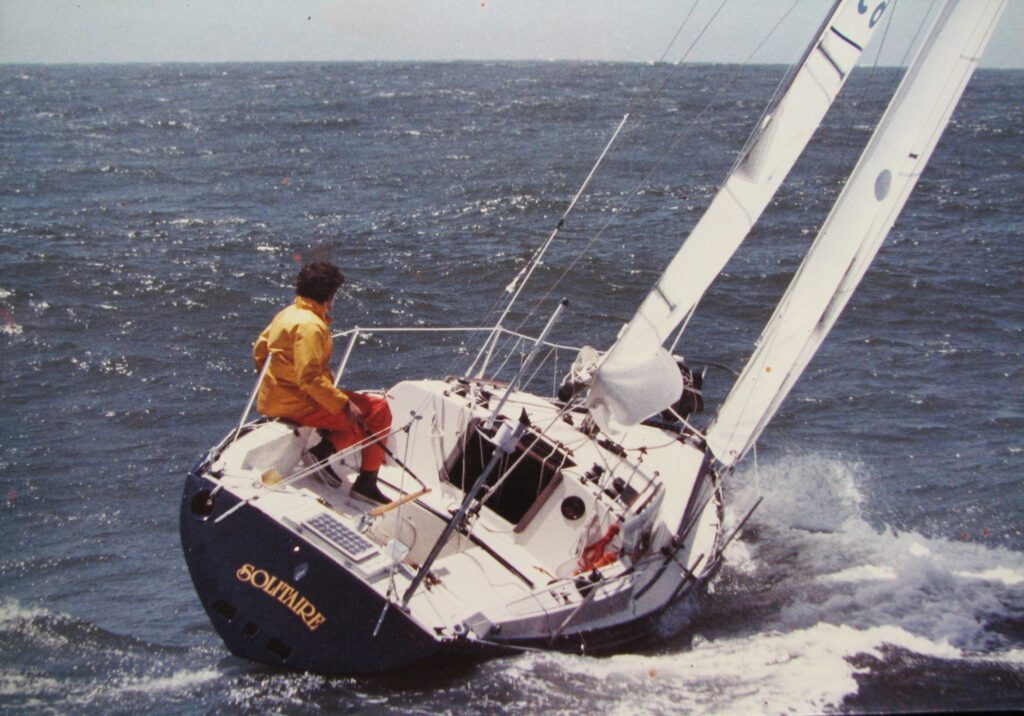
The first ocean waves leaving San Francisco in the single handed race to Hawaii*
We have been caught in a trap of valuing progress as a panacea for every problem and unfulfilled wish. Blinded by the rapid expansion of wealth and comfort, we could not see the damage it was causing personally and to the earth. As we face the consequences of our collective myopia, drastic changes will be required to live on this planet. To adapt will require courage, resilience and cooperation. Resilience is a word that is used a lot by people writing about the polycrisis, but often they are speaking of creating physical or social infrastructure to help a community survive, or just simple preparedness measures like having extra batteries for your flashlight. I am interested in exploring the psychological and spiritual qualities that allow an individual or group to survive and sometime even thrive in adverse conditions. Webster defines resilience as: 1) the capability of a strained body to recover its size and shape after deformation caused especially by compressive stress. 2) an ability to recover from or adjust easily to misfortune or change.
Part one: working with residual wounds from our culture and family.
As the Corona Virus lock-down lifts, the burning question coming from individuals and the media is: “When will we return to normal?” I propose that the real question is: “How do we live now?” Not that the virus will last indefinitely, but it has sounded an alarm loud and clear that the system is out of balance. We have a choice of heeding the alarm and altering the way we live on the planet, and how we live with each other, or pretending that we can get back to “normal”.
The virus has heightened awareness of injustice in society, but it is only the tip of the iceberg. Economic inequality is growing. protests in the past such as Occupy Wall Street have had little permanent impact. The capitalistic system is hardwired to accumulate wealth and power to those who already posses both. The systems has no mechanism for self correction. Any change in direction must come from an outside force, from the people who are not getting a fair deal.
But perhaps it is too late for that. The fires in the West, the hurricanes and flooding in other areas of the county tell a story that the outside force that brings down the system will not be human but the workings of nature herself. Prophesies in every major religion point to some form of collapse. Most people hear all the news, but do not put all the pieces together and see the severity of the crisis we are facing.
So my question is; how do we live now? How do we live when we have no precedent? How do we live when the external structures we have depended on are no longer reliable?
Looking to Our Origins
Darcia Narvaez author of “Neurobiology and the Evolution of Human Morality; Evolution, Culture and Wisdom”, begins with a statement that the natural cultural unit that we have evolved with is a band of 20 to 30 people, living and working and caring for their children as a cohesive unit. Most aboriginal cultures have evolved in similar groups. Childcare is a group effort so no infant or child ever feels abandoned or unwelcome. That is the foundation for adults with the resilience to navigate difficult times without lashing out in anger or giving up in resignation. The recent work on neurobiology confirms the practices of the aboriginals. During the first 6 months of life it is essential for the infant to be held, to feel safe, to be fed when it is hungry and live free from trauma in order for the nervous system to develop a healthy relationship with the world. To experience the environment most American babies live in, a working mother forced to bottle feed the child and possibly leave it in a daycare center leads to an adult who does not feel safe in the world and regards the world as a threat. His natural reaction is either belligerence or withdrawal.
Only when we can assess the situation without reacting from a core level of fear can we make accurate decisions. Ilarion Merculieff primary instructions are to live from your heart. He goes on to say that to do that each of us must resolve the traumas and heal the wounds that block our access to the inherent wisdom of the heart. Most of us were raised to follow the instructions of the adults around us. After years of ignoring our own instincts to follow the rules of the adults, we are expected to suddenly become autonomous humans capable of making our own intelligent decisions. Unfortunately our connection with our inner wisdom has usually atrophied and we end up placing our trust in in some external authority of worse some demagogue.
To live in these rapidly changing times requires taking back our own autonomy. Once we feel safe, we can cooperate with others and feel comfortable modifying our desires or opinions to work toward he common good. The different therapeutic modalities and self help methods available today are too numerous to count. What is important? First there must be a willingness to look within, to face our fears, our sense of inadequacy, and to question the beliefs we have held about the world and ourselves. then we need a friend, a group or even a therapist to help us gain insight into our patterns of thought and behavior that are invisible to our own eyes.
The belief that the world is fundamentally spirit descended into matter is foundational in all aboriginal cultures. It gives each person a wider field of view, a perspective that allows them to view their own personal predicament with a sense of safety by seeing it as part of a larger play. With the exception of twelve step programs, most western therapy misses this essential piece. The therapist becomes the “Higher Power” which ends up being both confusing and disappointing. The question remains as to how does each individual come to have an unshakable knowledge of the existence of something greater. There is a commonly held view that in the twelve step program the addict has to “hit bottom”, or in other words reach a point of seeing that his personal will to change is inadequate and is willing to ask for help from something greater. It is a unique situation, one that most of us would not voluntarily choose. Based on my my own experience, that trust cannot be instilled by merely attending church on Sunday. It must be direct revelatory experience. Aboriginal cultures relied on rituals such as the vision quest and rites of passage. It seems essential to reestablish rituals like that in our culture. The challenge in our risk averse comfort seeking culture is to create rituals that are not so sanitized that they loose their potency.
If each individual is aware and accepting of his place as one unit in an incredibly complex web, then creating a society that supports the individual, and honors the limitations of the ecosystem follows naturally. Likewise once the culture exists it is relatively easy for the individual to find his place within that sustainable system. Our challenge is that we do not have the culture to guide us so we must create it. That will be the next topic.
Posted inUncategorized|Comments Off on How Do We Live Now?
The more interconnected the world becomes electronically, we
as individuals are moving toward greater separation from each other, from the
natural world and from an understanding of the true gravity of our
situation. Those who do grasp the larger
picture often retreat into denial either out of fear or hopelessness. Even the scientists who may be acutely aware
of the crisis in their own fields do not grasp the additional risk from the
interconnectedness of the multiple stressors on the system.
This web site is a place to explore the larger picture, to come to terms with the astonishing interconnectedness of climate, energy production, economic growth, pollution, political tension and more. Once we grasp the almost impossibility of turning the ship then we can look beyond the collapse and explore what could rise out of the ashes of this culture. Focusing on the cyclic nature of all created things, it is intended to raise our focus to the larger vision of what could rise out of the collapse of the present system. Any successful new society must be collaborative. Using that model, this site can hopefully serve as a hub for the exchange of knowledge about what systems have worked in the past; in particular the Native American spiritual, political social and economic systems that enabled them to live in harmony with nature for over 10,000 years.
Posted inUncategorized|Comments Off on Roadmap to this Site
What can this site offer the viewer?
In a world that is incredibly complex, we are bombarded by information. The media tends to focus on the next news item or short term prediction that will stir the emotions of the viewer or reader so they will not turn off the station. This web site is about taking a step back and looking at the big picture.
____________________
This site is under construction. Please come again to see what is new.
Index to Articles -Originally published on Resiliance.org