
One:
Endless growth. We’ve created a system of economics based on valuing money and charging interest for its use. Every time that the bank loans money, it is creating more money and for the use of that money we pay interest. The only way to repay that interest is to keep the economy and private businesses growing, funneling the profits to the banks, investors and taxes to support federal spending. Unfortunately, representatives in a democratic government are reelected only if they can give their constituents consistent bonuses. We want all the things we think will make our life better and our representatives in Congress want to give us those things so the government is continuously going further into debt. On the private side corporations have to keep selling us more things in order to survive. They too have to pay interest and reward stockholders with growth or dividends. They are trapped into having to make more appealing products so they can sell them to people who don’t even need them. All of this consumes and ever increasing amount of resources. The Earth, however, is finite. It can only give so much before the ecosystem collapses and the mines play out.
Number Two
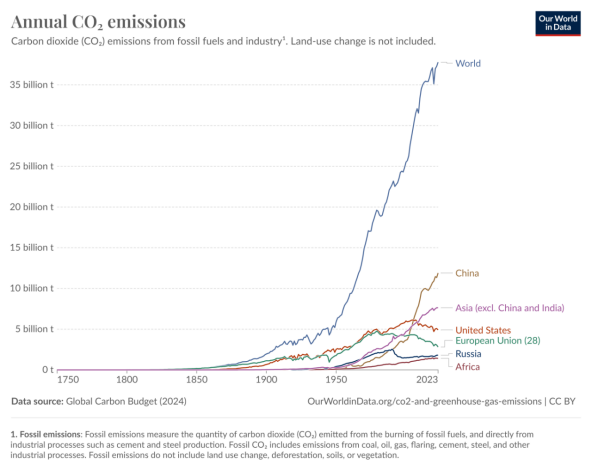
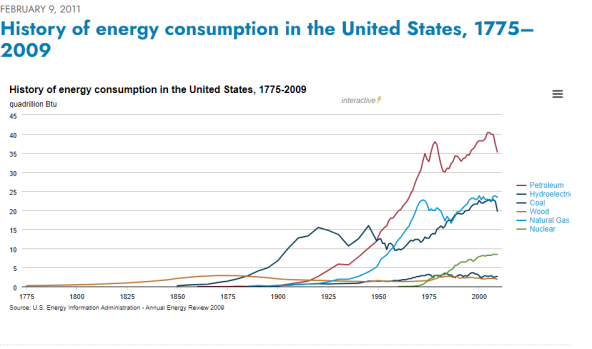
Environmentalists hold on to the belief that if only we can produce enough solar panels, we can transition from fossil fuels to renewables without giving up our lifestyle of high energy consumption. There is no evidence that this is ever happened. Instead, each new energy source merely adds to the original source. When coal replaced wood, the consumption of wood actually increased in England because there is more need for wood to shore up the mines and for railroad ties and other construction. When oil replaced coal, coal consumption kept increasing because it was needed to produce steel for the industrial revolution. Looking at the current situation, wind and solar are increasing rapidly, but other sources are not decreasing. The total energy consumption keeps increasing as we grow more hungry for stuff and grow more people to use it. Each time a new energy source comes online, there is a tremendous need for new infrastructure to support it and that requires energy from the old modes of energy production. The problem is that it takes more energy to extract energy from the newer sources then from the originals. For instance, early oil wells produced 100 barrels of oil for every barrel expended in drilling, now that ratio is down to 16:1 or less. The cost of converting to wind and solar would consume vast amounts of resources. We can migrate away from fossil fuels for energy, but we will have to reduce our energy consumption by 50% to 70%.
Number Three
The Earth can support 10 billion people.
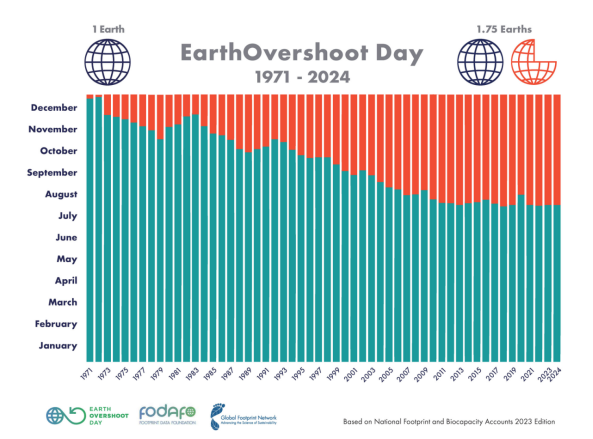
According to the global footprint network, we are currently using 1.7 earths. If we want to bring all people on the planet up to some decent standard of living that number would radically increase. Yes we could probably support 10 billion people if we all lived in extreme poverty, but not too many of us are willing to go back to living in thatched huts, traveling by bicycle and working long hours to grow enough food in our minimal plot of land to survive. Various experts have estimated that the carrying capacity of the earth is between one and 3 billion people. How do we get there? If we keep going with business as usual, the Earth will show us how. It will not be pleasant. We are already getting a taste when we look around the world and look at the floods, the fires, the wars, the famine. Perhaps of even greater concern is the loss of other species. The Earth is an unimaginably complex web of species some of which we don’t even know yet, and they are all important. The danger extreme danger in the present is that we humans will try to maintain our lives at the expense of the natural world and we will destroy the fundamental building blocks of life on this planet through environmental degradation, chemical pollution, and radical climate change.
Number Four
We cling to the illusion that through our technology and our “superior“ intelligence, we can maintain a stable and comfortable life now and in the future. We believe that through geoengineering such as carbon capture we can mitigate the damage we have already done and continue on with business as usual. All solutions cost more energy, and it is precisely the continual increase in our extraction of energy that is the problem. The solution is to reduce our energy consumption rather than create new technologies that increase consumption, even if they give us a momentary pause in climate disruption.
Here in the United States we have been isolated from the long term history of Europe and Asia with the rise and fall of multiple empires, and as a result we forget or ignore that every empire in history has risen to prominence and then collapsed when its geography or population exceeded the capacity of the land or government to govern or feed their people.
We can look at this as a failure of the human being, an inevitable outcome of his hubris, but it is a more mechanical process than that. Biologist are familiar with the pattern among animals of overshoot and collapse as the population grows past the point that their land base can sustain the herd. The population then collapses to a point well below the initial population because the terrain has been stripped of everything edible and takes years or decades to return to its productive level. Looking at it from a systems view, it is a matter of the feedback mechanism that tells the humans or the animals to stop producing young is delayed past the point where a stable population can be maintained. Humans have better better access to data. But we are very bad at making use of that information and turn a blind eye on the fact that we don’t want to see. For 25 years it’s been clear that climate change is the greatest threat to humans and animals that that we have faced since the evolution of Homo Sapiens, but we made only superficial steps to solve the problem, and half the population of our country still denies climate change is real, even as they get flooded out of their home.
Number Four
We cling to the illusion that through our technology and our “superior“ intelligence, we can maintain a stable and comfortable life now and in the future. We believe that through geoengineering such as carbon capture we can mitigate the damage we have already done and continue on with business as usual. All solutions cost more energy, and it is precisely the continual increase in our extraction of energy that is the problem. The solution is to reduce our energy consumption rather than create new technologies that increase consumption, even if they give us a momentary pause in climate disruption.
Here in the United States we have been isolated from the long term history of Europe and Asia with the rise and fall of multiple empires, and as a result we forget or ignore that every empire in history has risen to prominence and then collapsed when its geography or population exceeded the capacity of the land or government to govern or feed their people.
We can look at this as a failure of the human being, an inevitable outcome of his hubris, but it is a more mechanical process than that. Biologist are familiar with the pattern among animals of overshoot and collapse as the population grows past the point that their land base can sustain the herd. The population then collapses to a point well below the initial population because the terrain has been stripped of everything edible and takes years or decades to return to its productive level. Looking at it from a systems view, it is a matter of the feedback mechanism that tells the humans or the animals to stop producing young is delayed past the point where a stable population can be maintained. Humans have better better access to data. But we are very bad at making use of that information and turn a blind eye on the fact that we don’t want to see. For 25 years it’s been clear that climate change is the greatest threat to humans and animals that that we have faced since the evolution of Homo Sapiens, but we made only superficial steps to solve the problem, and half the population of our country still denies climate change is real, even as they get flooded out of their home.